Your reader finishes the last chapter, turns the page, and runs into a wall of unfamiliar terms — or a stack of supporting documents with no explanation. This is where back matter earns its keep. Two sections do most of the heavy lifting: the appendix and the glossary. The appendix vs glossary question is really a question about what your reader needs to look up: long reference material, or short definitions? Get that distinction right and everything else — order, formatting, cross-references — falls into place.
By the end of this guide, you will know exactly what separates an appendix from a glossary, how to decide which one your book needs (many books need both), where each one sits in the standard back-matter order, and how to format each for print and ebook: headings, alphabetical entries, cross-references, and page numbers versus hyperlinks. You will also get the seven mistakes that mark an amateur interior and a final checklist before you publish. If you want the deep page-by-page mechanics, our appendix and glossary formatting guide covers them in full; this guide is the decision-making companion.
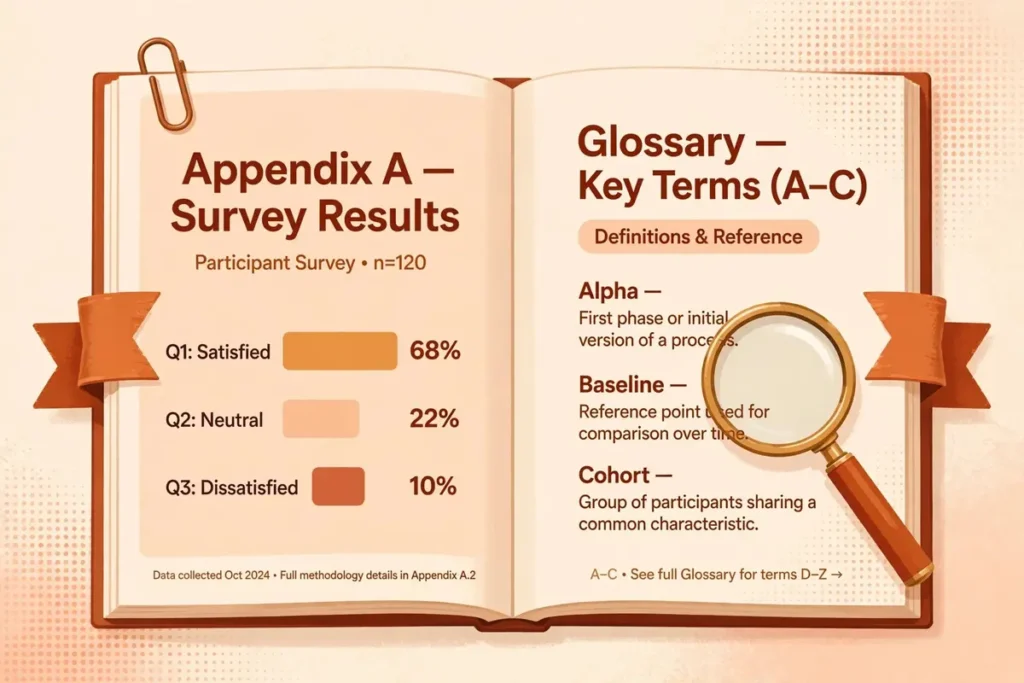
Quick answer: In the appendix vs glossary decision, remember this: an appendix is a section of supplementary material — documents, timelines, data tables, maps, extended examples — numbered and organized by topic (Appendix A, Appendix B). A glossary is an alphabetical list of terms used in the book, each with a short definition. Use an appendix when readers need reference material; use a glossary when your book uses jargon, invented terms, or foreign words readers must be able to look up. Many nonfiction and genre books need both. Format both with your chapter heading styles, alphabetize glossary entries, number appendices, and use hyperlinks in ebooks and page numbers in print.
In this guide
- Appendix vs Glossary: What Each One Actually Is
- Which Does Your Book Need? The Decision Guide
- Where Each One Sits: The Standard Back-Matter Order
- How to Format an Appendix for Print and Ebook
- How to Format a Glossary for Print and Ebook
- Cross-References That Actually Work in Print and Ebook
- 7 Back-Matter Mistakes That Mark an Amateur Interior
- Final Checklist: Back Matter Ready to Publish
- Frequently Asked Questions
- Conclusion: Give Readers a Back Door Into Your Book
Appendix vs Glossary: What Each One Actually Is
An appendix (plural: appendices) is a self-contained section of supplementary material that supports the main text but would interrupt its flow. Think of it as the drawer where you put everything the reader might want but the narrative cannot carry: full documents, interview transcripts, timelines, data tables, maps, questionnaires, extended examples, worksheets, or a note on your research method. It hangs off the main body of the book — attached but separate.
A glossary is an alphabetical mini-dictionary of terms used in the book: each term in bold followed by a concise definition. It exists for one job — letting a reader look up an unfamiliar word in seconds and get back to reading. It covers jargon, technical terms, foreign words, abbreviations, and invented vocabulary in genre fiction. A glossary never explains at length; if a definition needs a paragraph, that material probably belongs in the text or an appendix.
So the appendix vs glossary distinction is simple: appendices hold things, glossaries define words. An appendix answers “where can I see the full document?”; a glossary answers “what does that word mean?” Confuse the two and you get the two classic failures: a glossary bloated with essay-length entries nobody can scan, or an appendix crammed with term definitions nobody can find.
Which Does Your Book Need? The Decision Guide
Run your manuscript through this test. If readers will encounter supporting material too long for a chapter — a survey questionnaire, a full interview, a timeline, a data set — you need an appendix. If readers will encounter words they cannot be expected to know — industry jargon, invented fantasy terms, Latin phrases, military abbreviations — you need a glossary. Many books legitimately need both: the glossary defines the vocabulary, the appendices hold the evidence.
Genre patterns help you decide fast. Nonfiction how-to books usually need an appendix for templates, checklists, and worksheets, plus a glossary if the field has real jargon. Memoirs and histories lean on appendices for documents and timelines and rarely need glossaries. Fantasy and science fiction live on glossaries — our military sci-fi formatting guide treats the jargon glossary as one of the subgenre’s most-read sections. Business books tend to need a glossary for acronyms and an appendix for frameworks. Cookbooks want an appendix for conversion charts, not a glossary.
When in doubt, ask beta readers, not your manuscript. If two or more readers flag the same confusing term, it belongs in the glossary. If readers want to see the data behind a claim, it belongs in an appendix.
Where Each One Sits: The Standard Back-Matter Order
Back matter follows a conventional order, and readers — plus librarians, reviewers, and distributors — expect it. After the final chapter comes the epilogue or afterword, then the appendices, then the glossary, then endnotes, the bibliography or references, the index, and finally the about-the-author page. The logic runs from largest units to smallest: whole supplementary sections first (appendices), then the word-level reference (glossary), then notes, sources, and the index.
Two placement notes professionals follow. First, multiple appendices come before the glossary, never after — a reader flipping to the back should meet the big reference sections in descending order of scope. Second, the glossary sits close to the index, because both are lookup tools and readers browse them together. What you must never do is scatter: an appendix wedged between chapters, or glossary terms hidden in an appendix, breaks the reader’s mental map of the book.
How to Format an Appendix for Print and Ebook
Number your appendices and give each one a real title: “Appendix A — Reader Survey Questionnaire” beats a bare “Appendix A” every time. Letters (A, B, C) are the publishing standard; numbers work too, but never mix the two in one book. Style the appendix heading exactly like your chapter headings — same font, size, and spacing — so the back matter feels like part of the book, not an afterthought stapled on.
Each appendix starts on a new page in print and gets its own entry in the table of contents. Inside, number tables and figures within the appendix (“Table B.1”, “Figure C.2”) so cross-references stay unambiguous. Refer to appendices from the main text with explicit pointers — “see Appendix B for the full data set” — because an appendix nobody is pointed to is an appendix nobody reads. In ebooks, make those pointers hyperlinks to the appendix anchor, and give each appendix a clean anchor target of its own.
Keep appendices tight. A good rule: if your appendices exceed about twenty percent of the book’s total length, reconsider — either the material belongs in the chapters or it belongs in a companion download.
How to Format a Glossary for Print and Ebook
The glossary lives or dies on scannability. List terms in strict alphabetical order, term in bold followed by its definition on the same line or with a hanging indent. Keep definitions to one or two sentences — the glossary is a lookup tool, not a second narrative. Alphabetize letter-by-letter, ignoring spaces and hyphens, and file “Mc” and “Mac” names as spelled rather than as pronounced. Decide your rule for plurals and verb forms up front (define the singular, cross-reference the plural) and apply it to every entry.
Cross-references inside the glossary use “See” and “See also”: “Trim size. See page size.” Every defined term should actually appear in the book — orphan entries that never occur in the text confuse readers and bloat the section. In print, you may add the page of first use after a definition, but keep it optional and consistent. In ebooks, never use page numbers; instead give the glossary its own TOC entry and consider hyperlinking key terms from the text on first use, as our print versus ebook formatting guide explains — reflow destroys fixed pagination, so links must be anchors, not numbers.
Cross-References That Actually Work in Print and Ebook
Cross-references are the connective tissue of back matter, and they fail in predictable ways. In print, references must carry page numbers — “see Appendix C, page 214” — and those numbers must be generated by your layout software’s cross-reference fields, never typed by hand. Hand-typed page numbers go stale the moment pagination shifts, and nothing looks more amateur than a pointer to a page that holds something else.
In ebooks, do the opposite: never cite a page number, because reflow means the reader’s page 214 is nobody else’s. Use hyperlinks to named anchors — from the text to the appendix, from the glossary term to its definition, from a “See also” to the related entry. The discipline is simple: print points with numbers, ebooks point with links, and both are generated, not typed.
7 Back-Matter Mistakes That Mark an Amateur Interior
1. The dumping-ground appendix. Material lands in the appendix because the author could not decide where it belongs, not because readers need it there. If you cannot write one sentence saying what an appendix is for, cut it.
2. Glossary entries that are essays. A 200-word “definition” is a chapter hiding in the back. Trim it to two sentences or move the material into the text.
3. Alphabetical order that is not. Entries sorted by first impression rather than by rule — “e-book” filed under E in one place and “ebook” under E somewhere else — tell the reader the book was never proofed.
4. Terms that do not match the text. The glossary says “bleed” but the chapters say “full-bleed”; the appendix cites a table the chapters never mention. Back matter must be reconciled against the final text, not against an early draft.
5. Back matter missing from the TOC. Readers cannot find what is not listed — give every appendix and the glossary a table-of-contents entry.
6. Page numbers in ebooks. “See page 47” in a reflowable EPUB is a broken promise. Ebook cross-references are hyperlinks, full stop.
7. Formatting that changes at the back. Different heading styles, different fonts, different spacing in the appendices signal that back matter was pasted in from another document. Style it like the rest of the book.
Final Checklist: Back Matter Ready to Publish
Run this checklist on a printed proof (for print) and on an exported EPUB (for ebook) before you upload anything.
- Appendices numbered consistently (all letters or all numbers) with descriptive titles
- Glossary in strict alphabetical order, every term actually used in the book
- Back-matter order: appendices, then glossary, then notes and index
- Every appendix and the glossary listed in the table of contents
- Print cross-references use generated page numbers; ebook cross-references are hyperlinks
- Appendix and glossary heading styles match the chapter headings exactly
- Glossary spellings, plurals, and diacritics match in-text usage everywhere
- Ebook proof: every back-matter hyperlink tested on a real device or app
Frequently Asked Questions
Conclusion: Give Readers a Back Door Into Your Book
Back matter is not the place where books go to be ignored — it is the reference system that makes a book usable for years. The appendix vs glossary decision is the foundation: appendices carry the material, the glossary carries the language, and each one earns its place only if readers can find it, scan it, and trust it. Number the appendices, alphabetize the glossary, keep both in the standard order, and wire every cross-reference for the format it serves — and your back matter becomes a feature readers dog-ear, cite, and return to long after the story ends.
Get your back matter formatted like a professional reference
ArrowUpz builds appendices, glossaries, and full back-matter sequences that readers can actually navigate: numbered appendices with descriptive titles, clean alphabetical glossaries with working cross-references, print editions with generated page numbers and ebook editions with tested hyperlinks — delivered as a print-ready PDF and a reflow-safe ebook.
Basic Formatting — $97 per book
Professional Formatting — $147 per book
Premium Formatting — custom quote