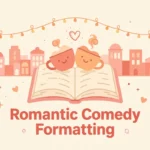
Romantic comedy is the genre where the joke and the kiss have to land on the same page. A reader picks up a rom-com because they want to laugh and fall in love at the same time, and they will forgive a heroine who trips over her own feet but not a book whose banter is buried under a wall of text. Formatting is what makes that banter readable: short exchanges, clean scene breaks, and chapters that end on a laugh instead of a lecture.
The stakes are real. Rom-com readers are some of the fastest readers in self-publishing, and they talk. A book that reads smoothly gets recommended in group chats and finished in a single sitting; a book whose dialogue runs together or whose scene changes confuse gets a polite two-star review and no recommendation. When you format a romantic comedy novel, you are not decorating the manuscript. You are protecting the timing.
This guide covers every formatting decision that matters for a rom-com, from banter and comedic timing to meet-cutes, dual point of view, tropes, heat level, and series back matter, plus a pre-publish checklist at the end.
Quick answer: To format a romantic comedy novel, build a clean reflowable ebook with short dialogue paragraphs, a new paragraph for every speaker, clear scene breaks, dual point-of-view labels where needed, chapter hooks that end on a laugh or a twist, and a working table of contents; format the print edition at 5.5 x 8.5 or 6 x 9 inches; keep the tone consistent from the meet-cute to the happily ever after; and finish with series back matter that leads readers to your next book.
In this guide
- What Makes a Romantic Comedy Different to Format
- Banter and Dialogue: Formatting the Joke
- Comedic Timing: Scene Breaks, Beats, and White Space
- The Meet-Cute and Chapter Structure
- Tropes: How Formatting Supports the Setup
- Tone and Heat Level: Keeping the Book Consistent
- Series Formatting: Recaps, Also By Pages, and Back Matter
- Ebook Versus Print: Trim Size, Fonts, and KDP
- Frequently Asked Questions
- Conclusion: A Format That Lets the Jokes Land
What Makes a Romantic Comedy Different to Format
A romantic comedy reads differently from other romance novels because the comedy sets the pace. Jokes need white space. A punchline buried in the middle of a dense paragraph does not land, and a witty exchange stretched across one long block of text reads like a monologue. Rom-com pages carry more white space than almost any other genre, and that is a feature, not a flaw.
The second difference is the reader’s expectation of tone. A rom-com reader expects lightness, even when the story touches serious subjects. Your formatting should match that lightness: clean, uncluttered pages and a layout that never looks like a textbook.
The third difference is speed. Rom-com readers binge. They read on phones, often at night, and finish a book in one or two sittings. Your ebook has to reflow cleanly on a phone screen at the smallest font size. Heavy front matter and long unbroken chapters will cost you readers before the first joke lands.
Banter and Dialogue: Formatting the Joke
Banter is the engine of a romantic comedy, and formatting is what keeps it running. The first rule is absolute: every new speaker gets a new paragraph, without exception. Two characters trading one-liners in a single paragraph is unreadable, and it kills the rhythm of the exchange. Give each line its own paragraph so the eye can follow the back-and-forth at speed.
The second rule is to keep dialogue paragraphs short. A rom-com exchange is usually one or two sentences per line, with the occasional longer speech for a confession or a rant. Long paragraphs of narration between dialogue lines slow the pace and bury the jokes. Break narration into short paragraphs, and let the conversation carry the scene.
Action beats and dialogue tags need the same care. A beat like “she said, rolling her eyes” should sit on the same line as its dialogue, not stranded on a line of its own. Too many beats between every line will choke the exchange; use them sparingly, and let the words do the work.
Comedic Timing: Scene Breaks, Beats, and White Space
Comedy is timing, and in a book, timing is white space. A scene break after a punchline gives the reader a beat to laugh; a chapter that ends on a joke gives the reader a reason to start the next one. Format your scene breaks so the reader can feel them. The safest choice is a centered ornament, such as three asterisks or a small heart, with blank space above and below. Never rely on a blank line alone to signal a scene break in an ebook, because reflowable text can swallow a blank line at a page turn and merge two scenes without a divider.
Chapter length matters for timing too. Rom-com chapters work best between 1,500 and 3,000 words, short enough that each chapter can end on a laugh, a twist, or a disaster. A chapter that runs past 5,000 words blunts the hook, because the reader cannot feel the chapter structure at all. End chapters on a question, a revelation, or an awkward moment, and give the next heading white space before it, so the joke lands and the reader turns the page.
Pacing within a scene follows the same logic. A fast, funny scene should be mostly dialogue with short paragraphs. A slower, emotional scene can carry longer paragraphs, because the reader needs time to feel it. Vary the paragraph length deliberately: short paragraphs for speed and laughs, longer ones for warmth and feeling.
The Meet-Cute and Chapter Structure
The meet-cute is the most important scene in a romantic comedy, and it deserves a chapter structure that shows it off. Give the meet-cute its own chapter, or at least its own clearly marked scene, so the reader can find it again and so the moment feels like an event. A meet-cute buried in the middle of a long chapter feels like an accident; a meet-cute that opens or closes a chapter feels like a promise.
Chapter headings can do work for a rom-com. A heading that names the viewpoint character, such as “Chapter Three — Nora,” helps the reader follow dual point of view, and a playful chapter title can set the tone before the first line. If you use chapter titles, keep them short and consistent, and apply a real heading style to every one so your table of contents picks them up.
The opening chapters carry a burden: they must introduce the couple, establish the tone, and deliver the first laugh, all within the first few pages. Keep your front matter short so the story starts fast. A reader who must scroll through five pages of dedication and author notes before the meet-cute may never reach it.
Tropes: How Formatting Supports the Setup
Rom-com tropes are not just plot devices; they are formatting signals. Enemies-to-lovers needs a clear point-of-view rhythm, because the reader has to feel both characters’ irritation and their slow thaw. Fake dating needs visible scene breaks, because the story jumps between public performances and private confessions. Grumpy-sunshine needs a consistent voice for each character, so the grump’s dry lines and the sunshine’s bright lines never blur together.
Dual point of view is the most common way to serve these tropes, and it needs labels. Most rom-coms alternate between the hero and the heroine chapter by chapter, and readers expect to know whose head they are in within the first line of every chapter. The simplest signal is a chapter heading that names the character, used in the same pattern for every chapter. If you use first person for both characters, the labels matter even more, because the voice alone will not tell the reader who is speaking.
Tone and Heat Level: Keeping the Book Consistent
Tone is the hardest thing to format, because it lives in the writing, but formatting can protect it or undermine it. A rom-com that suddenly looks like a thriller, with long dense chapters and heavy scene breaks, will feel wrong even if the words are funny. Keep your formatting light and consistent from the meet-cute to the happily ever after: the same chapter headings, the same scene-break ornament, the same paragraph style, all the way through.
Heat level is a formatting decision as much as a writing decision, because it shapes your front matter, your categories, and your cover. Decide your heat level before you format — sweet, steamy, or somewhere in between — and make sure every part of the book agrees. Your front matter should state the heat level plainly, and your cover should signal it, so a reader who wants a sweet comedy never opens a steamy novel by mistake. Content warnings belong in the front matter, on their own page, right after the copyright page and before the story begins. List the specific content in plain language, without spoilers, and keep the list short and specific.
Series Formatting: Recaps, Also By Pages, and Back Matter
Most romantic comedy authors write series, whether interconnected standalones set in the same small town or one couple’s story told across several books, and series formatting has its own rules. Every book after the first needs a short recap, usually a paragraph or two woven into the opening chapter, that reminds returning readers who the characters are and what happened before, without boring new readers who picked up the book first. Format the recap as ordinary narration, not as a separate “previously on” page.
Your back matter is where a series earns its next sale. The moment a reader finishes your happily ever after, put a “what to read next” page immediately after the final chapter, with the cover and title of the next book and a working link to its Amazon page. Follow it with an “also by” page listing your books in series order, then your author bio and newsletter signup. Rom-com readers who finish a book at midnight buy the next one at midnight, and a dead end after the last chapter is a lost sale. Our guide to how to format a romance novel covers the broader romance formatting choices if you are writing across the genre. Keep your formatting identical across books too, so the series looks and feels like a set.
Ebook Versus Print: Trim Size, Fonts, and KDP
The ebook and the print edition of a romantic comedy are two different products, and they need two different formatting passes. The ebook should always be reflowable, built from a clean Word document or EPUB with real heading styles, so readers can change the font size freely. Never upload your print PDF as your ebook. The result is fixed tiny text that rom-com readers, who often read on phones in bed, will abandon within minutes. Our guide to Kindle ebook formatting explains the ebook formatting choices in detail.
For the print edition, the standard rom-com trim sizes are 5.5 x 8.5 inches and 6 x 9 inches. The smaller size feels like a traditional mass-market paperback and suits shorter novels, while 6 x 9 gives longer books a more comfortable page count and slightly lower printing costs. Choose one size and use it for the whole series. For fonts, pick a readable serif such as Garamond or Caslon at 11 or 12 points, with a first-line indent of about 0.2 inches and no extra space between paragraphs. Our complete guide to formatting a book for KDP print walks through the print formatting workflow step by step, and a final pass with our book formatting checklist for self-published authors catches most of these issues before your book reaches readers.
Kindle Unlimited deserves special attention for romantic comedy, because the genre is one of the strongest performers in the program. When you format a romantic comedy novel for Kindle Unlimited, remember that you are paid per page read, so front matter should be short and the story should start fast. Put your “also by” pages and previews at the back, where they earn page reads, and make sure the link to the next book in the series is the first thing readers see after the final chapter.
- Give every new speaker a new paragraph and keep dialogue lines short
- Use a visible scene-break ornament, never a blank line alone, in the ebook
- Keep chapters between 1,500 and 3,000 words and end each one on a laugh or a twist
- Label every dual point-of-view chapter with the character’s name
- Give the meet-cute its own chapter or clearly marked scene
- Pick one tense per scene, then sweep the manuscript for slips
- Place heat-level and content warnings on their own front-matter page before chapter one
- Format each trope for its rhythm: clear POV for enemies-to-lovers, visible breaks for fake dating
- Add a “what to read next” page with working links immediately after the final chapter
- Match trim size, fonts, and heading styles across every book in the series
- Keep front matter short in the Kindle Unlimited edition
- Preview the ebook on a phone, a tablet, and an e-ink device before publishing
Frequently Asked Questions
Conclusion: A Format That Lets the Jokes Land
Good formatting in a romantic comedy is invisible: the reader should never think about your scene breaks or font choice, because they are too busy laughing and falling in love with your characters. That invisibility comes from the right choices: short dialogue paragraphs, visible scene breaks, chapters that end on a laugh, honest content warnings, and back matter that leads to your next book.
When you format a romantic comedy novel with those choices in place, you give your story the best possible chance to do its work. Format one clean file, test it on a phone and a tablet, and publish with confidence.
Get Your Romantic Comedy Formatted for Laughs and Love
Your meet-cute deserves formatting that protects the banter, the timing, and the happily ever after. Our formatters handle dual point of view, scene breaks, chapter hooks, and clean ebook and print layouts, so your readers laugh all the way to the last page.
Basic Formatting — $97 per book
Professional Formatting — $147 per book
Premium Formatting — custom quote