A police procedural lives or dies on its detail — the chain of custody, the interrogation transcript, the autopsy report that turns the whole case. When you format a police procedural novel for self-publishing, every one of those details has to read cleanly on the page: readers will forgive a slow chapter, but they will never forgive a timeline that contradicts itself because the formatting blurred who said what and when. This 2026 guide walks you through the genre’s unique demands — case-file chapter headers, evidence exhibits, transcript scenes — and it builds on the same principles as our detective novel formatting guide.
By the end, you will know how to structure chapters around the investigation, mark date, time, and location at each scene so readers always know where they are, format interrogations and official transcripts so the questions and answers are impossible to mix up, design case-file inserts and evidence exhibits that look professional in both paperback and eBook, choose the right trim size and typography for crime fiction, and run a final formatting checklist before you upload to KDP. Whether you write lone-wolf detectives or a whole precinct of viewpoint characters, the mechanics are the same.
Quick answer: To format a police procedural novel for self-publishing, open chapters with case-file style headers (chapter number, date, time, and location), set interrogation and transcript scenes with consistent speaker labels, place evidence exhibits in bordered blocks with numbered captions, keep dialogue formatting standard, and set the book in a readable serif at a 5 x 8 or 6 x 9 trim for print. Check every date, time stamp, and exhibit reference against your timeline before upload.
In this guide
- What Makes Police Procedural Formatting Different
- Chapter Structure and Case-File Headers
- Handling POV Shifts and Timeline Jumps
- Formatting Interrogation and Transcript Scenes
- Evidence Exhibits and Case-File Inserts
- Dialogue Formatting for Interrogations and Radio Calls
- Trim Sizes and Typography for Crime Fiction
- KDP Paperback and eBook Specifics for Procedurals
- The Police Procedural Formatting Checklist
- 7 Formatting Mistakes That Break Reader Immersion
- Frequently Asked Questions
- Conclusion: Make the Mechanics Disappear
What Makes Police Procedural Formatting Different
A police procedural is the one crime subgenre where the paperwork is the plot. Readers follow the chain of custody, the lab results, and the interrogation transcripts as closely as the detective does — which means your formatting carries evidentiary weight. A mislabeled exhibit or an unmarked point-of-view shift does not read like a design choice; it reads like a plot hole.
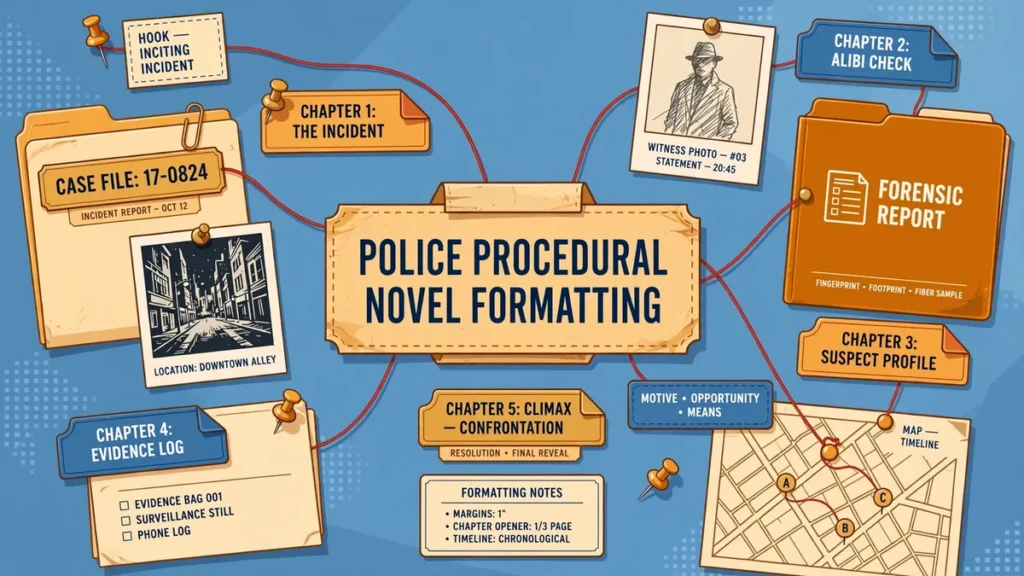
That gives the procedural five formatting elements other novels rarely need: chapter headers stamped with date, time, and location; interrogation and transcript scenes with strict speaker labeling; evidence exhibits and case-file inserts set apart from the narrative; multiple viewpoint characters across the precinct; and parallel timelines — the crime, the investigation, and the clock — running at once.
The payoff for getting this right is trust. When every chapter header follows the same pattern and every exhibit is numbered the same way, readers relax and investigate alongside your detective. And when you break the pattern once, deliberately, it lands like a clue — in this genre, format itself is a storytelling tool.
Chapter Structure and Case-File Headers
When you format a police procedural novel, the chapter opener has to do double duty: it must feel like the start of a chapter and read like the top of a case file. The standard pattern is a chapter number or title, followed by a smaller line giving the date, the time, and the location — for example, Tuesday, October 14, 2:47 a.m., Harbor Precinct, Interview Room 2.
Keep that stamp on its own line, set in small caps or italic, and never bury it in the first paragraph where skimmers miss it. Some authors add a case number to the header, such as Case File 17-0824, for series branding. In the eBook edition, the stamp must be real text rather than an image, so it scales cleanly on every screen size.
Procedurals cut between locations constantly, so your scene-break mark matters more here than in most genres. Use one consistent mark — a centered ornament, three spaced asterisks, or a simple blank-line gap — and use it everywhere. Readers learn your rhythm fast, and changing the mark mid-book feels like a dropped thread.
Handling POV Shifts and Timeline Jumps
Most procedurals rotate through several viewpoints: the lead detective, a partner, the medical examiner, sometimes the killer. Give every point-of-view shift its own chapter, or at minimum a clearly marked scene break. Never change viewpoint mid-scene without warning — a reader who misattributes a clue will blame your plot, not your layout.
Timelines need the same discipline. The crime happened on Tuesday, the investigation is running on Friday, and the flashback is three years old. Use your standard header pattern for flashbacks too, with the past date doing the work. Keep a master timeline document and check every header against it — one wrong date stamp destroys credibility instantly.
For parallel action — two teams hitting two locations at once — alternate short chapters with identically formatted headers. The matched rhythm tells readers the scenes are simultaneous without a word of exposition, and the tension builds itself.
Formatting Interrogation and Transcript Scenes
The interrogation room is the procedural’s signature set piece, and its formatting must be airtight. Set each exchange on its own line with a consistent speaker label — bold names, small caps, or Q. and A. — and keep the detective’s questions visually distinct from the suspect’s answers with a hanging indent or a subtle left border. Once the pattern is set, readers can scan ten pages and know instantly who is talking.
The same system handles 911-call transcripts, wiretap logs, and bodycam footage: set them as inset blocks with time stamps in brackets, like [02:14], marking each segment. Keep the treatment slightly distinct from body text — a touch smaller or indented — but always legible. Never use screenshots of text in an eBook; real text reflows, while images shrink into illegibility.
Long transcripts can stall momentum, so break them with brief action beats — a tapped pen, a glance at the one-way glass. Keep the speaker labels identical every single time. Consistency is what lets a reader follow a twenty-page interrogation without fatigue.
Evidence Exhibits and Case-File Inserts
Autopsy summaries, lab reports, crime-scene sketches, phone logs — exhibits are where procedurals feel most real, and they need a home on the page. Set each one as a bordered inset block with a numbered caption above it, like Exhibit 12-A: Toxicology Summary. Number exhibits sequentially through the whole book and never renumber late in the draft; a dangling reference to an exhibit that does not exist will cost you reviews.
Keep the design simple: a thin border or light tint, a caption in small caps, and a clean sans-serif at 9.5 or 10 points so the block reads like a document. Resist full-page exhibits in tiny type — summarize the document in the scene and let the exhibit deliver the one detail that matters. Our mystery-thriller formatting guide covers the same exhibit discipline for twist-driven plots.
In reflowable eBooks, keep exhibit blocks simple — border plus caption — because complex tables collapse on small screens. Test every exhibit in Kindle Previewer before you publish.
Dialogue Formatting for Interrogations and Radio Calls
Standard dialogue rules still govern the interrogation room: new speaker, new paragraph, no exceptions. Once the question-and-answer pattern is established, you can drop most dialogue tags and let the rhythm carry the scene — replace tags with action beats that keep the room alive. For the full rulebook on tags, beats, and punctuation, see our dialogue formatting guide.
Radio chatter and dispatch calls get their own treatment: call-sign labels like DISPATCH: and 4-ADAM-12:, often in italic or small caps, with transmissions kept short. Use the phonetic alphabet sparingly — a little jargon builds authenticity, but a page of it reads like static.
Phone calls need one consistent convention: italicize one side of the conversation, or mark the unheard side with em dashes. Choose the system in chapter one and never change it — readers learn your rules fast and forgive nothing when you break them.
Trim Sizes and Typography for Crime Fiction
For paperback, 5 x 8 inches and 5.5 x 8.5 inches are the crime-fiction standards — the sizes readers’ hands expect from the mystery shelf. Procedurals often run past 90,000 words, and at that length 6 x 9 inches keeps the page count, and the print cost, under control. Our thriller novel guide walks through the same trim-size trade-offs.
Set body text in a readable serif — Garamond, Caslon, or Minion — at around 11 points, with chapter titles given generous white space above. Use a clean sans-serif at 9.5 to 10 points inside exhibits so they feel like documents. Never set whole chapters in a typewriter font; one exhibit label is the limit.
KDP Paperback and eBook Specifics for Procedurals
Procedurals run long, so mind the gutter: as page count grows, inside margins must widen so text near the spine stays readable — KDP’s templates handle this automatically, so build on the template for your final page count rather than fighting it. Use running heads, with the book title on left pages and the chapter or case name on right, plus page numbers in the outside bottom corners; leave headers off chapter openers.
For the eBook, keep everything reflow-friendly: simple bordered exhibit blocks, no text boxes, no multi-column layouts. Drop caps and ornamental scene breaks generally survive Kindle conversion, but verify in Kindle Previewer across device profiles. Make sure front matter — title page, copyright page, contents — is hyperlinked and appears in the eBook’s navigation.
Finally, hunt widows and orphans: interrogation scenes full of short exchanges are widow factories, so run a final pagination pass with hyphenation on — and protect case numbers and exhibit labels with non-breaking spaces.
The Police Procedural Formatting Checklist
Run this list after your final draft and before you export for KDP.
- Every chapter opens with the same header pattern: chapter number or title, plus date, time, and location on its own line.
- Scene breaks use one consistent mark throughout — identical in the paperback and the eBook.
- Each point-of-view shift starts a new chapter or a clearly marked scene break — never mid-scene without warning.
- Every date and time stamp is cross-checked against a master timeline; exhibit numbers run sequentially with no gaps.
- Interrogation and transcript scenes use identical speaker labels, indentation, and time-stamp style every time.
- Exhibits sit in simple bordered blocks with numbered captions, and every block has been tested in Kindle Previewer.
- Trim size, margins, gutter, running heads, and page numbers match KDP’s template for the final page count.
- Front and back matter are complete: title page, copyright page, hyperlinked contents, and about-the-author page.
7 Formatting Mistakes That Break Reader Immersion
These seven errors show up in self-published procedurals constantly. Each one is cheap to fix before upload and expensive after.
Mixing header styles. Date stamps in chapter three but not chapter twelve train readers to stop trusting your timeline.
Unlabeled point-of-view changes. A surprise head-hop makes readers misattribute a clue — and blame the plot.
Image-based text. Screenshots of transcripts do not reflow; on a phone screen they shrink into illegibility.
Exhibit numbers that lead nowhere. “See Exhibit 9-B” with no Exhibit 9-B anywhere is an instant credibility loss.
Inconsistent speaker labels. Q. and A. in one interrogation, full names in the next — pick one system and keep it.
Pages of all-caps radio chatter. A paragraph of caps reads as urgency; a chapter of it reads as shouting.
Tiny type for “realism.” A lab report at 7 points might look authentic, but nobody can read it — legibility beats realism.
Frequently Asked Questions
Conclusion: Make the Mechanics Disappear
Your formatting is the case file your reader builds alongside the detective. Keep the headers consistent, the transcripts scannable, the exhibits numbered, and the timeline airtight — and the mechanics disappear, leaving only the mystery. Do that work before upload, and your procedural will read like it came from a major crime imprint rather than a first-time formatter.
Make your procedural read like a real case file
ArrowUpz formats police procedurals with the details the genre demands — case-file chapter headers, clean interrogation transcripts, numbered evidence exhibits, and print-ready files for KDP paperback and eBook — so your investigation reads flawlessly on every device.
Basic Formatting — $97 per book
Professional Formatting — $147 per book
Premium Formatting — custom quote