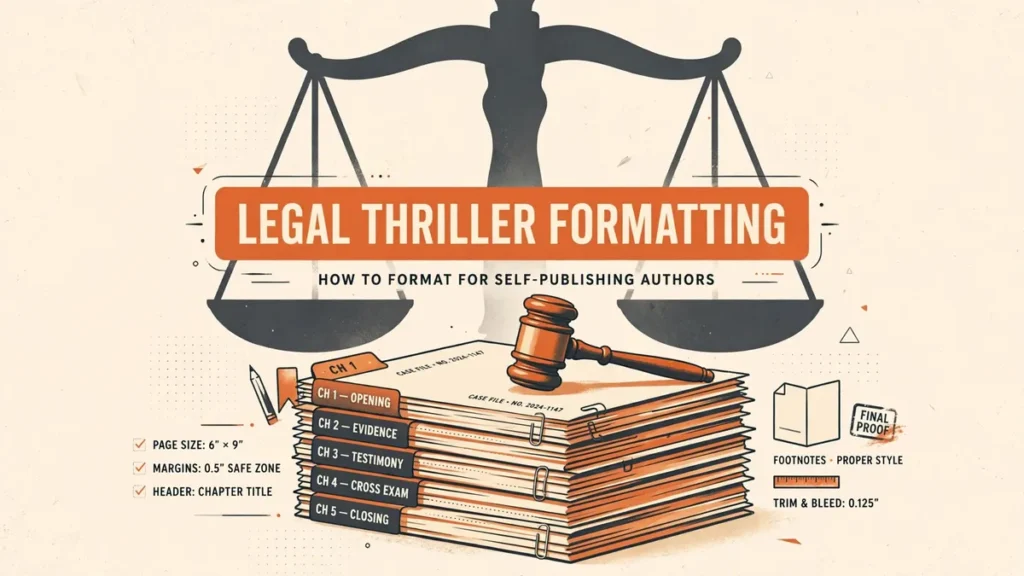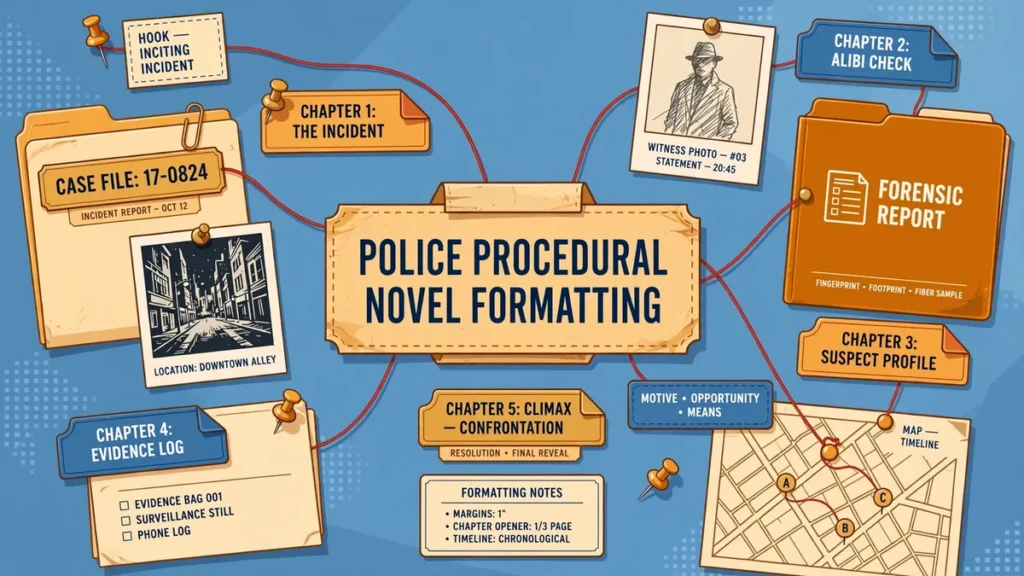
Learning how to format a true crime book is different from formatting any other nonfiction manuscript. You are part journalist, part storyteller, and part archivist — and your interior design has to carry case timelines, mugshots and maps, police-report excerpts, and hundreds of source notes without breaking the reading flow. The same discipline behind good nonfiction book formatting applies here, but true crime demands extras that genres like memoir or self-help never need, which is why starting from a dedicated true crime system beats adapting a generic template.
This 2026 guide walks you through every formatting decision that matters: the right trim size and chapter structure, how to build readable case timelines, where to place photo inserts and evidence exhibits, how to handle endnotes and bibliographies, typography that creates a noir mood without hurting readability, and the legal redactions that protect you from defamation claims.
Quick answer: Format a true crime book like serious nonfiction with a documentary edge. Use a 6 x 9 inch trim, a clear part-and-chapter structure with dated chapter openers, one master case timeline, a central photo-insert section with captioned images, endnotes instead of footnotes, a full bibliography and index, and redacted names wherever legal exposure exists. Set body text in a readable serif at 10.5 to 11.5 points, and let the noir mood live in the chapter design — never in gimmicky body typography.
In this guide
- What Makes True Crime Formatting Different
- Choose the Right Trim Size and Chapter Structure
- Building Case Timelines Readers Can Follow
- Photo Inserts and Evidence Exhibits
- Front Matter, Parts, and Back Matter: The Full Structure
- Source Notes, Endnotes, and Bibliographies
- Typography and Chapter Openers With a Noir Mood
- Redacting Names and Protecting Yourself Legally
- Your Pre-Publish True Crime Checklist
- Frequently Asked Questions
- Conclusion: Build the Case on the Page
What Makes True Crime Formatting Different
True crime is one of the few genres where formatting does investigative work. Readers arrive expecting to follow a case the way a detective would: chronology, evidence, motive, verdict. Your layout has to serve two masters at once — the page-turning narrative and the evidentiary record.
Three things separate true crime interiors from ordinary nonfiction. First, the timeline is the spine. Cases unfold over years, and readers need constant orientation — dates, locations, and a clear sense of who is who. Second, the evidence is visual: photographs, newspaper clippings, maps, and mugshots all need a home that does not interrupt the story. Third, credibility is the product. A reader who doubts your sources closes the book, so notes, citations, and a transparent methodology are not optional extras — they are the genre’s contract with the reader.
This hybrid nature is why templates built for fiction or general memoir fall short: the skeleton of your book must be journalistic — dated, sourced, and verifiable.
Choose the Right Trim Size and Chapter Structure
The first major decision when you format a true crime book is trim size. For 2026 KDP paperbacks, 6 x 9 inches remains the industry standard for narrative nonfiction. It keeps line lengths comfortable, gives timelines and exhibit references room to breathe, and keeps print costs predictable. Larger sizes like 7 x 10 inches work when your book is heavy on maps, diagrams, or full-page exhibits, but they raise printing costs and can make the book feel like a dossier rather than a book.
Structure the book around investigative beats, not just chronology. A proven architecture is four parts: The Crime, The Investigation, The Trial, and The Aftermath. Each part opens on its own right-hand page with a part title; chapters inside carry date stamps in the opener, such as “March 14, 1987 — The Disappearance,” and every chapter is numbered for the eBook table of contents. If your book leans into suspense pacing, our mystery and thriller formatting guide covers chapter cliffhangers and pacing devices that true crime borrows from fiction.
Your front matter should include tools the reader will use constantly: a copyright page with legal disclaimers, an author’s note on methodology and sources, a dramatis personae (a cast-of-characters list, enormously useful when a case involves dozens of names), and a master timeline the reader can consult at any point. Place the dramatis personae and timeline where they are easy to find — readers will flip back to them all night.
Building Case Timelines Readers Can Follow
The case timeline is the single most important navigation tool in your book. Offer it in two places. First, a one- or two-page “Timeline at a Glance” in the front matter: a clean single-column list of date and event pairs covering the whole case. Second, a short mini-timeline at the start of each Part, showing only the events that part covers. This layered approach orients new readers without forcing veterans to re-read what they already know.
Follow strict formatting rules so timelines scan instantly. Use one consistent date format throughout, such as “March 14, 1987.” Set the date in bold and keep each entry to one or two lines — a timeline is an index of events, not a story. Build the master timeline in a spreadsheet first, check every date against your source notes, and only then typeset it.
Handle uncertain dates honestly. Mark approximations with “circa 1991” and flag disputed dates with a phrase like “date disputed — see note 47.” This protects your credibility far more than false precision ever could.
Photo Inserts and Evidence Exhibits
True crime readers expect to see the evidence. For KDP paperback, gather photographs into one or two dedicated 8- or 16-page insert sections placed near the middle of the book. Every image must be at least 300 DPI at its printed size — a photo that looks fine on your phone will print as a blurry smear at anything lower.
Caption every photograph: who or what is shown, when and where it was taken, in italic type slightly smaller than the body text. Rights are the real minefield. Mugshots and police photographs sit in a gray area that varies by jurisdiction; newspaper and wire-service photographs almost always require a license; family photographs require written permission. “Found on Google” is not a license, and printing an unlicensed photograph can get your book pulled. Credit every image source in its caption or a photo-credits page in the back matter.
For evidence exhibits — maps, floor plans, newspaper clippings, diagrams — consider redrawing them as clean line art rather than reproducing scans. Scans of old newsprint reproduce poorly, while a redrawn map with your own labels looks professional and avoids reproducing someone else’s copyrighted layout. Number exhibits sequentially (“Exhibit 3.2”) and reference them by number in the text. In the eBook edition, keep exhibit images modest in width and add descriptive alt text for accessibility.
Front Matter, Parts, and Back Matter: The Full Structure
A professional true crime book follows a predictable architecture. Use this reference when assembling your manuscript.
Much of the genre’s trust-building happens in the front and back matter. Reviewers, journalists, and the families involved check these pages first. A complete apparatus signals that you did the work; a missing one signals the opposite. If you are unsure how notes and citations should look, a dedicated guide to formatting bibliographies and references shows the standard patterns to follow.
Source Notes, Endnotes, and Bibliographies
Choose endnotes over footnotes for true crime. Footnotes clutter narrative pages and break the spell of a tense scene; endnotes keep the story clean while giving diligent readers a full paper trail in the back. Place a superscript note number at the end of the sentence the note supports, and group the notes in the back matter under chapter headings. Restart numbering with each chapter for the friendliest reader experience.
Your notes need a consistent citation style, and Chicago is the genre standard. Cite interviews with dates and identities (“Interview with Detective Maria Santos (ret.), March 3, 2024”). Cite court records with case name, docket number, court, and year. Cite Freedom of Information Act documents with the agency and file number — it shows reviewers you worked from primary sources rather than recycled news coverage. Newspaper citations need the publication, headline, date, and page or URL.
The bibliography gathers every source in one place: books, articles, court documents, interviews, documentaries, and archives. It is the first thing a serious reviewer checks, so completeness matters more than length. Paired with a short “Note on Sources” essay in the front matter, clean Chicago-style citations are what separate a documented investigation from an opinion piece.
Typography and Chapter Openers With a Noir Mood
Readers should feel the noir atmosphere without ever noticing the typography, which means restraint. Set body text in a classic serif — Garamond or Georgia — at 10.5 to 11.5 points, with line spacing around 1.3, justified margins, and first-line paragraph indents. Use no extra space between paragraphs; the indent is the paragraph break.
Put the mood in the chapter openers instead. Open each chapter with the chapter number in small caps, followed by a date line in bold (“MARCH 14, 1987”), followed by the chapter title in a strong display serif. A drop cap on the first paragraph or a small-caps first line adds a classic true crime feel without hurting readability. If you want a dossier flavor, use a typewriter-style font for exhibit labels or document headers only — never for body text.
Limit yourself to two typefaces: one serif for body text and one display face for headings and part openers. More than that looks amateur. For the eBook edition, keep styling simple and structural — Kindle devices and apps override fonts anyway, so rely on proper heading markup, lists, and spacing rather than visual tricks that will not survive conversion.
Redacting Names and Protecting Yourself Legally
Formatting a true crime book is partly a legal exercise. Before finalizing, decide who must be protected. Redact or pseudonymize the full names of minors, uncharged persons, and anyone whose identity is not essential; use initials or consistent pseudonyms and keep a private key mapping them to real names in a secure file — never in the manuscript. Blur faces and license plates in photographs where the law or decency requires it.
Your copyright page should carry standard disclaimer language: names changed where noted, dialogue reconstructed from interviews and records, and nothing in the book to be read as an accusation against any living person not convicted of the crimes described. Be careful with headings and pull quotes — labeling a chapter “The Killer” when its subject was acquitted can create real defamation exposure.
Consult a media or publishing lawyer before you publish, particularly if your book names living people, covers an ongoing case, or alleges criminal conduct. A one-hour legal review costs far less than a single defamation claim.
Your Pre-Publish True Crime Checklist
Run through this list with a printed proof in hand — screens hide mistakes that paper reveals.
- Master timeline verified against source notes; disputed or approximate dates flagged
- Every photograph captioned (who, what, when, where) and rights-cleared with source credited
- Exhibits numbered sequentially and referenced by number in the text
- Endnotes numbered correctly, grouped by chapter, matched to every superscript reference
- Bibliography complete in Chicago style, with FOIA file numbers and interview dates
- Names redacted or pseudonymized per legal review; private key stored outside the manuscript
- Index checked for all key names, places, and case names
- EBook table of contents links tested on a real Kindle device or app
- Print PDF checked: fonts embedded, images at 300 DPI, no text in the margins
- Physical proof copy ordered and read cover to cover before approving distribution
Frequently Asked Questions
Conclusion: Build the Case on the Page
A well-formatted true crime book does two jobs at once: it pulls readers through a gripping narrative and hands them the evidence to judge the case for themselves. Get the trim size right, build a timeline readers can trust, place your photos and exhibits where they belong, document everything in endnotes and a full bibliography, and redact responsibly. Do that, and your self-published book will stand beside traditionally published true crime on any shelf — because readers judge credibility by the apparatus, and now yours is complete.
Your case file deserves a courtroom-ready book
ArrowUpz formats true crime books end to end — timelines, photo inserts, exhibits, endnotes, and indexes — so your investigation reads like it came from a major publisher, not a weekend project.
Basic Formatting — $97 per book
Professional Formatting — $147 per book
Premium Formatting — custom quote